Why you can't automate accounting workflows with Claude, ChatGPT, or Gemini
Here’s the pitch you’ve heard a dozen times this year: plug a frontier model into your ERP with an MCP connector, add a clever prompt, and watch it run your back office. It demos beautifully. Someone types “chase our overdue invoices,” the model queries NetSuite, drafts a few polite emails, and the room nods. Then it never ships. Because a demo is a magic trick, and accounts receivable is a job.
Why don’t you point Claude to it?
The horizontal assistants — Claude, ChatGPT, Gemini — are genuinely extraordinary. That’s not the argument. The argument is that reasoning is the easy 20% of AR, and everyone is racing to automate the part that was never the bottleneck.
Here’s what the connector-plus-prompt crowd keeps missing. A chatbot is a pull system — it waits for a human to ask. AR is a push and proactive system. The work is: it’s day 47 on invoice #4471, the customer half-paid last quarter, their AP contact just changed, and someone needs to follow up today — before it ages another bracket. No one is sitting there typing that prompt for ten thousand invoices a month. If the work doesn’t start itself, it doesn’t happen. An assistant that waits to be asked has already lost the game AR is played in.
One counter-argument is that I can automate a lot of it through a patch work of Co-Work, Agent SDK or Agent Builder and some glue code. One could, but it again, misses the vertical focused business context that is needed to deliver meaningful improvements to financial outcomes. Not to mention, this has to be maintained, monitored and improved. Models used with the right vertical focused and domain aware harnesses will outperform horizontal plays.
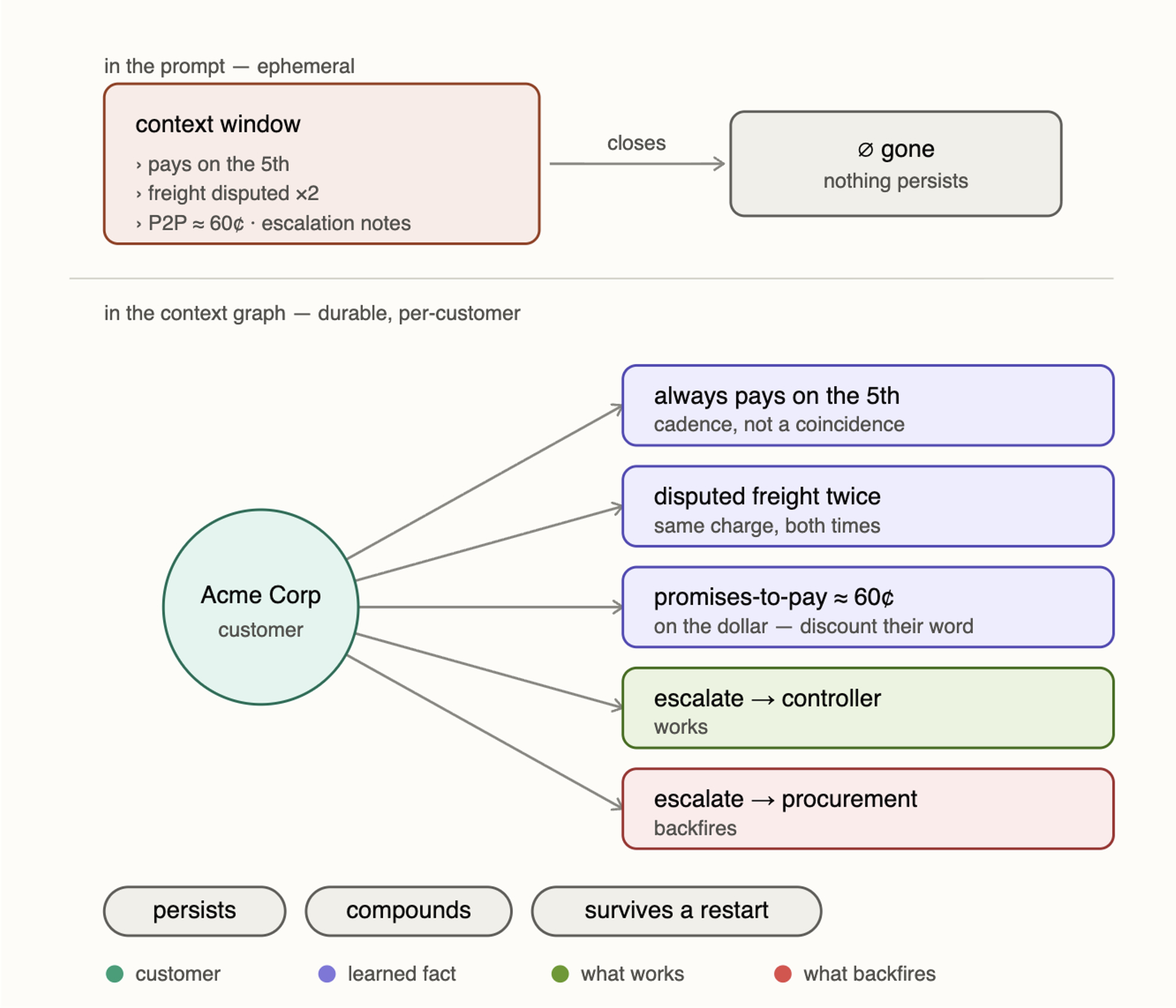
Moreover, a context window is not a system of record. Collections is a relationship that unfolds over months. It depends on remembering that this customer always pays on the 5th, that they disputed freight charges twice, that promises-to-pay from this contact are worth about 60 cents on the dollar, and that escalating to their controller works but escalating to procurement backfires. Paste that into a prompt and it’s gone the moment the window closes. You don’t need a smarter model here — you need durable, per-customer memory that persists, compounds, and survives a restart. That’s an architecture, not a system prompt.
“I asked AI” is not an Audit Trail
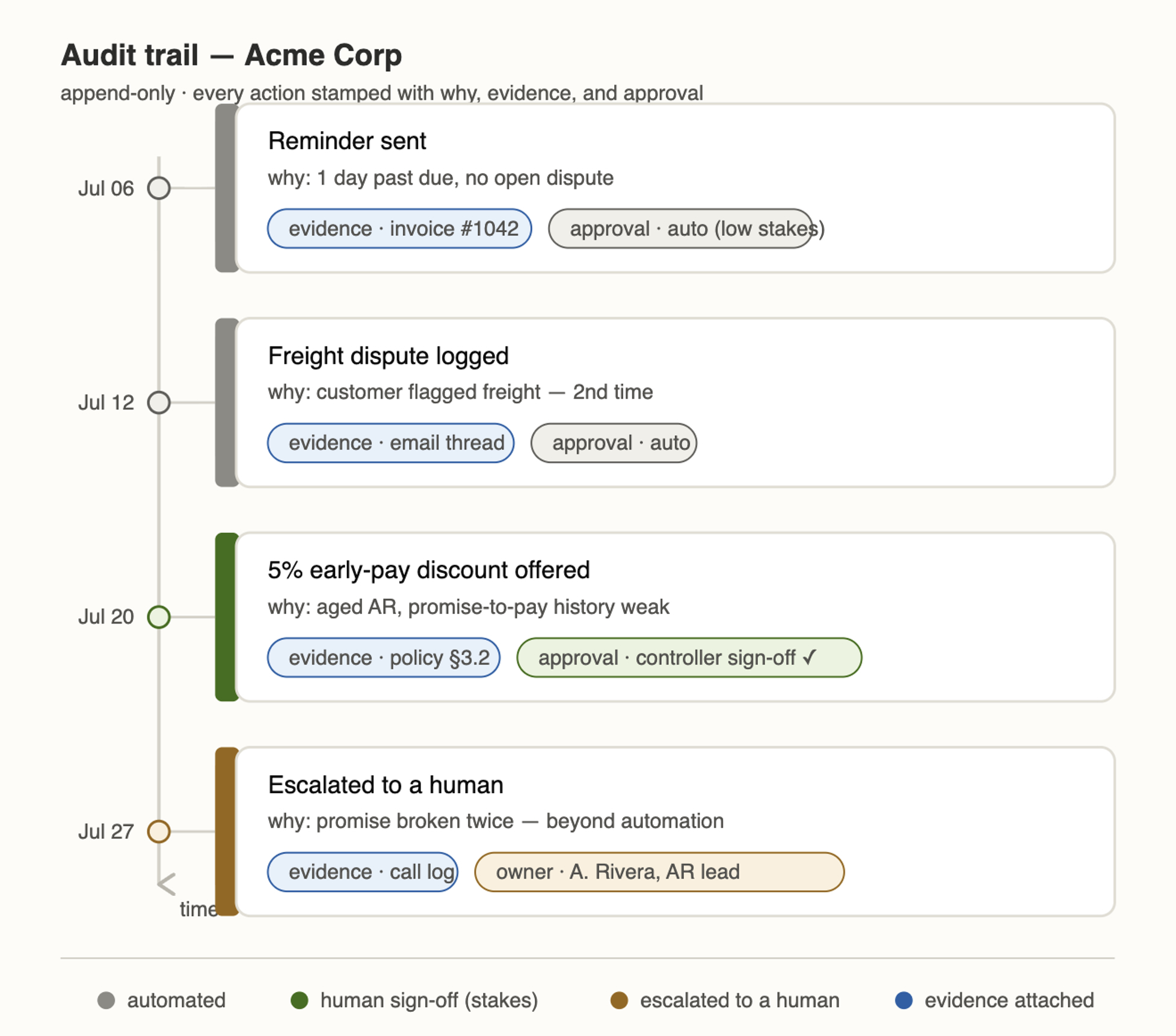
Every collection touch, every discount offered, every dollar applied has to carry a rationale, an evidence trail, an approval where the stakes demand it, and a clean escalation path to a human. Finance runs on accountability. A conversation you can’t reproduce, audit, or explain to a controller isn’t automation but a liability.
Answering a question is not owning an outcome. Ask a horizontal tool “what should we do about overdue invoices?” and you’ll get a thoughtful answer. Nobody’s DSO moves. Real automation owns the goal — get DSO to 45 days — and then plans, acts, adapts when a customer goes quiet, and self-corrects when a tactic stops working. That’s the difference between a tool that advises and an agent that’s accountable. One makes you feel productive. The other changes the number your CFO reports to the board.
**So what’s MCP actually good for? **
It’s the plumbing — the standard way to give a model access to your systems. That’s real, and it matters. But plumbing is not the appliance. Handing a brilliant generalist a set of API keys doesn’t make it your collections team any more than handing me a scalpel makes me a surgeon. The connector is the easy part. The hard parts — the always-on orchestration, the memory, the deterministic guardrails, the audit trail, the accountability for a business outcome — are the entire job. They have to be built, deliberately, for the domain.
That’s the line between horizontal and vertical AI, and it’s not going to blur. A general model with a connector can tell you about your receivables. Automating them is a different discipline entirely: purpose-built agents, running the whole workflow, owning the result.
You can’t prompt your way to that. You have to engineer it.